
Why Is My Room Still Humid with the Air Conditioner On?

A room can still feel humid with the air conditioner on if the air conditioner is not removing enough moisture, or if moisture is entering the room faster than the air conditioner can remove it.
Common causes include an oversized air conditioner, short cycling, high fan speed, weak cooling coil performance, humid outdoor air leakage, poor ventilation balance, wet indoor sources, or poor airflow circulation.
An air conditioner can remove humidity, but it is not the same as a dedicated dehumidifier. It removes moisture only when warm humid air passes over a cold cooling coil for enough time. If the system cools the room too quickly, does not run long enough, or allows too much humid air to enter, the room may become cold but still feel sticky.
Key Takeaways
How an AC Removes Humidity
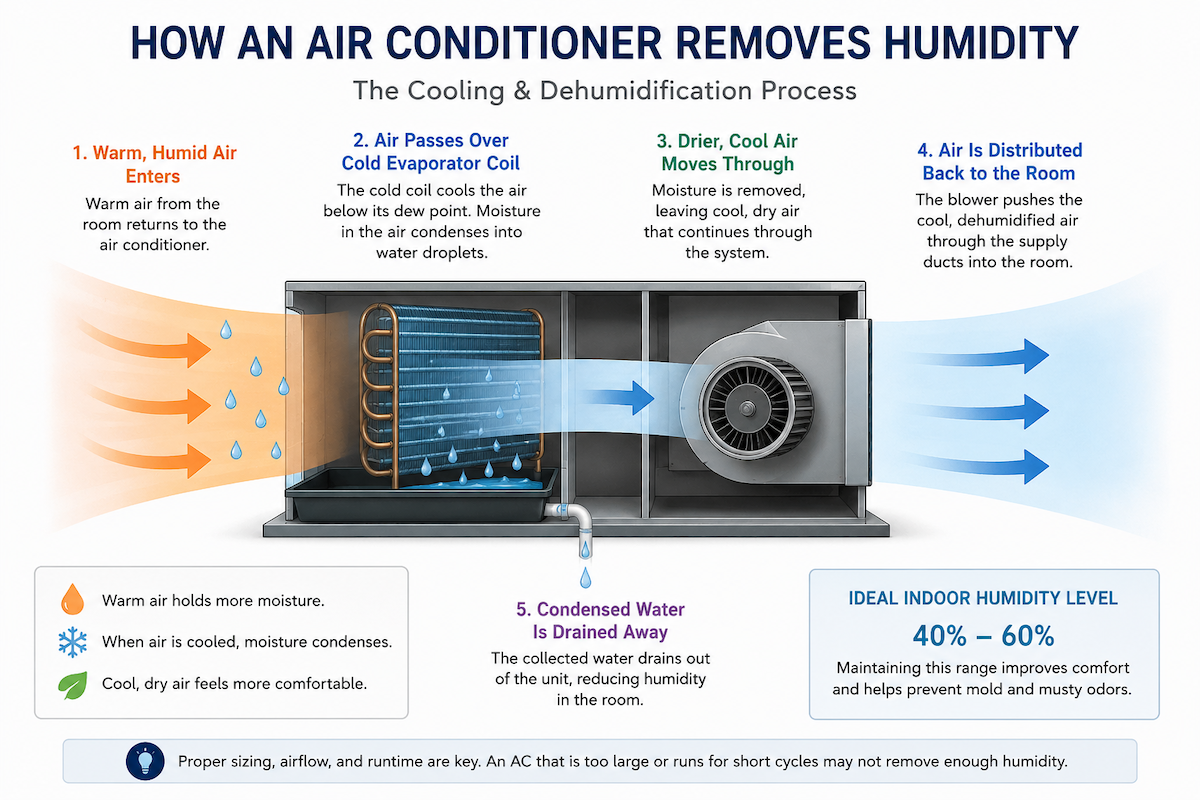
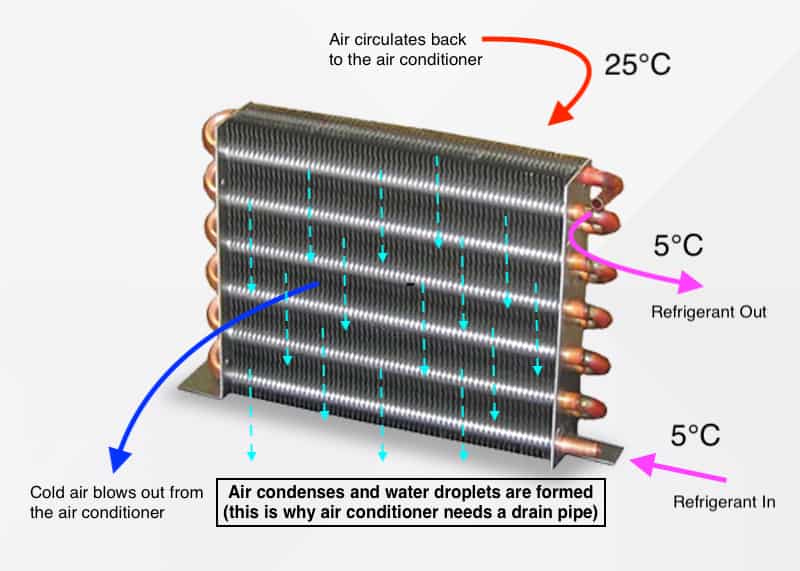
An air conditioner removes humidity when warm indoor air passes over a cold cooling coil.
If the coil surface is cold enough, moisture in the air condenses into water. This water collects in the drain pan and flows out through the condensate drain pipe.
The process is:
- Warm humid room air enters the indoor unit.
- The air passes across the cold cooling coil.
- Moisture condenses on the coil surface.
- Condensate water flows into the drain pan.
- The drain pipe removes the water.
- Cooler and drier air returns to the room.
This is why air conditioners produce water during normal operation.
If your room is still humid, the problem is usually one of these:
The air conditioner is not removing enough moisture, or moisture is entering the room faster than the air conditioner can remove it.
What Humidity Level Should You Have?
For comfort, many air-conditioned rooms feel best around 50% to 60% relative humidity.
If the room stays above about 65% relative humidity, it may start to feel sticky, damp, or uncomfortable, even if the temperature is already low.
| Room Condition | How It Usually Feels |
|---|---|
| 24°C (75°F) and 50% RH | Comfortable for many people |
| 24°C (75°F) and 70% RH | Cool but sticky |
| 27°C (80.6°F) and 55% RH | Warm but not necessarily sticky |
| 22°C (71.6°F) and 75% RH | Cold, damp, and uncomfortable |
This is why room temperature alone does not tell the full comfort story.
A room can be cold but still humid.
Field Note
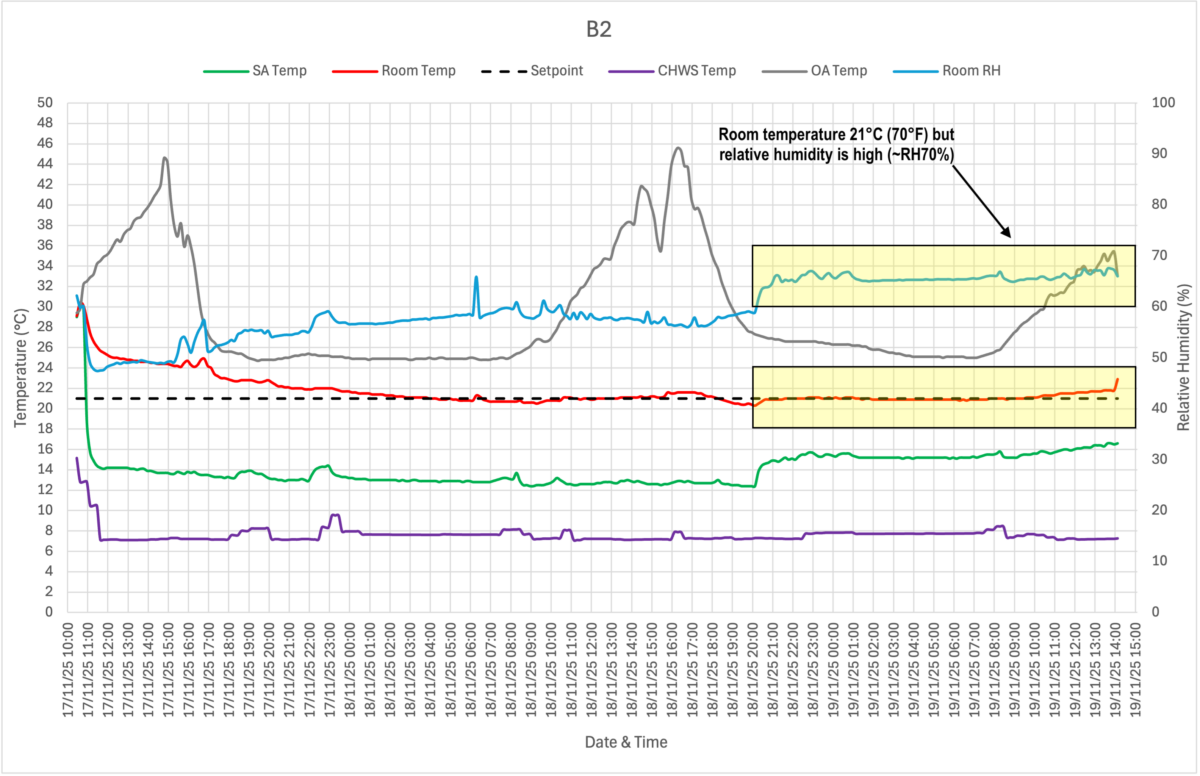
The above is the data logger trend graph from one of my site checks, the room temperature was around 21°C (70°F) but the relative humidity was near RH70%. The occupant felt uncomfortable even though the room was technically “cold.” This is a good reminder that comfort depends on both temperature and humidity, not temperature alone.
How to Confirm If It Is Too Humid
Before assuming the air conditioner is faulty, measure the room humidity.
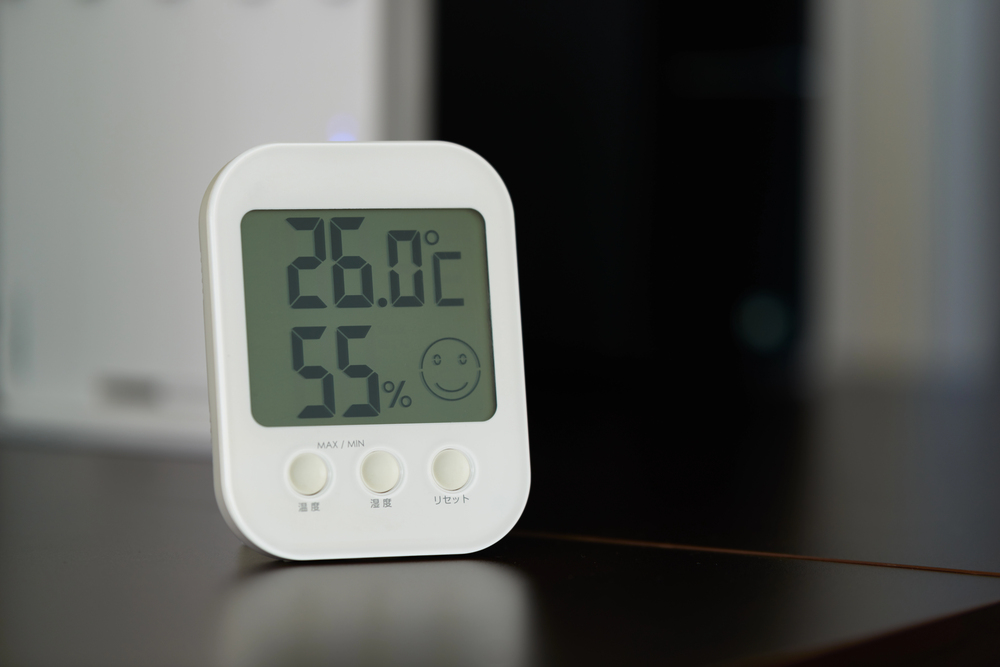
Use a simple digital hygrometer and check the room condition upon turning on the air conditioner.
Measure and observe:
- Room temperature
- Relative humidity
- Whether the room feels sticky
- Whether condensate water is draining
- Whether the compressor runs continuously or stops quickly
- Whether the room becomes humid again after the compressor stops
A humidity measurement is useful because “feels humid” can sometimes be confused with poor airflow, high room temperature, or uneven cooling.
Practical check:
| Reading | Possible Interpretation |
|---|---|
| 24–26°C (75-79°F) and 50–60% RH | Usually acceptable comfort |
| 24–26°C (75-79°F) and above 65% RH | Room is likely too humid |
| Below 23°C (73.4°F) and above 70% RH | Cold but damp condition |
| High RH with little condensate water | Coil may not be removing enough moisture |
| RH drops slowly but rises quickly again | Moisture source or outdoor air leakage may exist |
1. The Air Conditioner Is Oversized
An oversized air conditioner is one of the most common reasons a room feels humid
When the AC capacity is too large, it cools the room very quickly. The thermostat reaches the set temperature fast, so the compressor stops before enough moisture is removed.
This is called short cycling.
Humidity removal needs runtime. The air conditioner must operate long enough for room air to repeatedly pass across the cold coil and for moisture to condense and drain away.
If the AC only runs for short periods, it may reduce room temperature but leave too much moisture in the air.
Example
A small bedroom only needs around 9,000 btu/hr (1.0 HP or 2.5 kW), but a 24,000 btu/hr (2.5 HP or 7.1 kW) air conditioner is installed.
The room temperature drops quickly from 30°C (86°F) to 24°C (75°F). The compressor stops after a short runtime. The air feels cold, but the humidity remains high.
This can make the room feel:
- Cold but sticky
- Damp
- Clammy
- Musty over time
- Uncomfortable during sleeping
How to Check
Your AC may be oversized if:
- The room cools very quickly
- The compressor frequently starts and stops
- The room feels cold but humid
- The AC does not run continuously for long periods
- The problem is worse at night or during rainy weather
A properly sized air conditioner should not only cool the room. It should also run long enough to remove moisture.
Field Note
I have seen this happen in bedroom where the installed AC capacity was around 18,000 btu/hr for a room of about 90 sqft. The room reached the set temperature quickly, but the occupant still complained that the air felt sticky. In that case, the issue was not simply “not enough cooling,” but poor humidity removal due to short runtime.
2. The Fan Speed Is Too High
High fan speed can sometimes reduce moisture removal, especially when the air conditioner is already oversized.
When the indoor fan runs too fast, air passes across the cooling coil quickly. This can reduce the contact time between the air and the cold coil.
High airflow is useful for room circulation, but it is not always best for dehumidification.
Most air conditioners are rated at high fan speed. If the installed air conditioner is oversized, lowering the fan speed will reduce its capacity. Though the effect is minor, it could solve your humidity issues.
If your room is already cool but still humid, try using:
- Low fan speed
- Medium fan speed
- Auto fan mode
- Dry mode
Many users set the fan to high because they want the room to cool faster. That can help with temperature, but it may not help with humidity.
For humid conditions, lower fan speed often gives the coil more time to remove moisture from the air.
In some rooms, changing from high fan speed to low improved the comfort even though the temperature setting stayed the same. This usually happens when the air conditioner is just slightly oversized.
3. The Set Temperature Is Too Low
Setting the air conditioner too cold does not always solve humidity problems.
If the room temperature becomes very low while humidity remains high, the room can feel cold, damp, and uncomfortable.
For example, a room at 21°C (70°F) with high relative humidity may feel clammy. The user may lower the temperature further, thinking the AC is not working well. But the real issue is not temperature. It is humidity.
A better approach is usually:
- Set the temperature around 24–26°C (75-79°F)
- Use low or auto fan speed
- Let the AC run steadily
- Reduce outdoor air leakage
- Try Dry mode when the room is humid but not hot
The goal is not simply colder air.
The goal is comfortable air, which means proper temperature, humidity, and airflow.
4. The Cooling Coil Is Not Cold Enough
The cooling coil must be cold enough to remove moisture.
If the coil is not cold enough, the air conditioner may still blow slightly cool air, but the dehumidification effect may be weak.
Possible causes include:
- Dirty indoor coil
- Dirty outdoor coil
- Low refrigerant
- Incorrect refrigerant charge
- Weak compressor performance
- Poor heat rejection at the outdoor unit
- Sensor problem
- Control problem
This is more technical and usually needs proper checking.
Signs the Coil May Not Be Performing Well
The cooling coil may not be removing enough moisture if:
- The AC runs for a long time but the room stays warm and humid
- Supply air is not very cold
- Very little condensate water drains out
- The outdoor unit is dirty or poorly ventilated
- Cooling performance has become worse over time
- The AC used to work well but no longer performs properly
In humid weather, a normal air conditioner should usually produce condensate water. If the room is humid and very little water drains out, the cooling coil may not be removing much moisture.
Field Note
In troubleshooting cases, I would check the filter condition, coil cleanliness, refrigerant condition and chilled water supply temperature (for chilled water fan coil). The important point is that humidity complaints should not be judged by room temperature alone. Coil condition and actual moisture removal matter.
5. Humid Air Is Entering the Room
In hot and humid climates, outdoor air contains a lot of moisture.
If humid outdoor air keeps entering the room, the air conditioner has to remove that moisture continuously.
Common leakage paths include:
- Open doors
- Window gaps
- Poorly sealed sliding doors
- Gaps around pipe penetrations
- Ceiling gaps
- Fresh air openings
- Exhaust fans pulling air from outside
- Poorly sealed attic or roof spaces
- Frequent door opening
This is common in bedrooms, offices, shops, and restaurants.
Example
A room has an exhaust fan running continuously. The exhaust fan removes indoor air from the room or nearby toilet.
To replace the exhausted air, humid outdoor air is pulled in through door gaps, window gaps, or ceiling openings.
The air conditioner now has to cool and dehumidify this incoming air.
If the outdoor air leakage is high, the room may never feel properly dry.
What to Check
Look for:
- Doors or windows not sealing properly
- Strong air movement under doors
- Exhaust fans operating all the time
- Gaps around ceiling or wall penetrations
- Fresh air openings without control
- Outdoor air entering from adjacent spaces
Humidity problems caused by outdoor air leakage often become worse during rainy days or very humid weather.
In engineering, this phenomenon is what we called hot air infiltration. It is also very common on unfinished or incomplete wall construction that leaves multiple holes above the ceiling.
6. The Room Has an Internal Moisture
Sometimes the moisture source is inside the room.
Common indoor moisture sources include:
- Wet clothes drying indoors
- Attached bathroom
- Water leaks
- Damp walls
- Wet floor
- Aquarium
- Many indoor plants
- Cooking nearby
- Poorly ventilated toilet
- Many occupants in a small room
- Fresh plaster, paint, or renovation moisture
An air conditioner can remove moisture, but it has a limit.
If moisture is continuously added into the room, the AC may struggle to keep the humidity low.
Example
A bedroom has an attached bathroom.
After showering, the bathroom door is left open and the exhaust fan is weak. Humid bathroom air enters the bedroom.
The air conditioner cools the bedroom, but the air still feels damp.
In this case, the air conditioner may not be the main problem. The bathroom moisture must be controlled.
7. The AC Is Not Running Long Enough
Dehumidification takes time.
If the AC is frequently switched on and off, the room may not become dry enough.
This can happen when:
- The AC is oversized
- The thermostat reaches set temperature too quickly
- The user turns off the AC once the room feels cold
- The AC is used only for short periods
- The thermostat sensor is located in a cold spot
- The indoor unit blows cold air directly back toward its sensor
When the compressor stops, moisture removal also reduces significantly.
For better humidity control, the AC usually needs steady operation. That’s why inverter ACs are usually better at managing indoor humidity.
What to Try
Run the AC continuously for a longer period at a moderate set temperature, such as 24–26°C (75-79°F) , with low or auto fan speed.
If comfort improves, the issue may be runtime and control rather than cooling capacity alone.
8. Moisture on the Coil or Drain Pan
After the compressor stops, the indoor fan may continue running.
If water remains on the coil or in the drain pan, some of that moisture can evaporate back into the room air.
This can happen when:
- The fan runs continuously after cooling stops
- The drain pan has standing water
- The drain pipe slope is poor
- The drain pan is dirty
- The indoor unit is not installed level
- The AC frequently short cycles
This is usually not the only cause, but it can contribute to a room feeling humid again after the compressor stops.
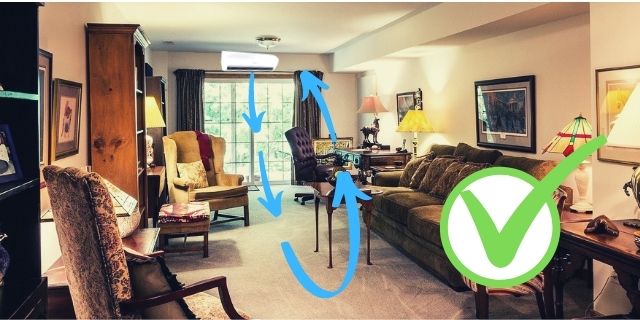
9. Poor Air Mixing In the Room
Sometimes the whole room is not equally conditioned.
The area near the air conditioner may be cool, while another part of the room remains warmer and more humid.
This can happen when:
- Indoor unit location is poor
- Furniture blocks airflow
- Fan speed is too low for the room layout
- The room is long and narrow
- There are partitions or curtains blocking air circulation
- The unit blows cold air directly back into itself
- The return airflow path is poor
In this case, the AC may be removing some moisture, but the room air is not mixing well.
What to Check
Walk around the room and compare comfort in different areas.
Check whether:
- Cold air reaches the occupied area
- Air returns properly to the indoor unit
- Curtains, cabinets, or partitions block airflow
- The indoor unit is too close to a side wall
- The room shape prevents proper circulation
Good humidity control needs good air circulation.
10. The AC Is in Cool Mode
Cool mode focuses mainly on reducing room temperature.
Dry mode focuses more on moisture removal. In many split units, Dry mode reduces fan speed and adjusts compressor operation to remove humidity without making the room too cold.
Dry mode is useful when:
- The room is humid but not very hot
- The weather is rainy
- The room feels sticky
- The temperature is already acceptable
- You want better comfort without overcooling
However, Dry mode is not a solution for every humidity problem.
It may not solve the issue if:
- The AC is badly oversized
- Humid outdoor air keeps entering the room
- The cooling coil is dirty or weak
- The room has a strong internal moisture source
- The system has poor airflow distribution
Dry mode can help, but it cannot fix poor design, major leakage, or equipment faults.
Quick Troubleshooting Checklist
Use this checklist if your room is still humid with the AC on.
| Check | What It May Indicate |
|---|---|
| Room cools very quickly but feels sticky | AC may be oversized |
| Compressor starts and stops often | Short cycling |
| Fan speed is set to high | Moisture removal may be weaker |
| Humidity is worse during rain | Outdoor air leakage or high moisture load |
| Bathroom door is open | Moisture entering from bathroom |
| Clothes are drying indoors | Internal moisture source |
| Very little condensate water drains out | Coil may not be removing moisture well |
| AC runs long but room remains warm and humid | Capacity, refrigerant, coil, or airflow issue |
| Room feels humid after compressor stops | Re-evaporation or short cycling |
| Some areas feel worse than others | Poor air mixing |
If the airflow is feeling weak, read this guide: Air Conditioner Low Airflow? Try these fixes now.
Simple Fixes You Can Try First
Before assuming the air conditioner is faulty, try these basic steps.
1. Use Dry Mode
Use Dry mode when the room is humid but not very hot.
Let it run for at least 30 to 60 minutes and compare the comfort.
2. Reduce Fan Speed
Try low or medium fan speed instead of high fan speed.
This may improve moisture removal.
3. Set a Moderate Temperature
Try 24–26°C instead of very low settings.
This can allow the system to run more steadily without making the room too cold.
4. Close Doors and Windows Properly
Reduce humid outdoor air entering the room.
Check window seals, door gaps, and frequent door opening.
5. Control Wet Area Moisture
Close the bathroom door after showering.
Use exhaust ventilation.
Do not allow humid bathroom air to flow into the air-conditioned room.
6. Avoid Drying Clothes Indoors
Wet clothes add moisture to the room.
If you must dry clothes indoors, use proper ventilation or a dehumidifier.
7. Clean the Filter
A dirty filter can reduce airflow and affect cooling performance.
Clean the filter regularly.
8. Service the AC
If the AC has weak cooling, dirty coils, poor drainage, or low performance, servicing may be needed.
When a Dehumidifier May Be Better
A dehumidifier may be useful if the room is already cool but still too humid.
This can happen when:
- The AC is oversized
- The room has constant moisture sources
- The room temperature is already low
- You need humidity control without strong cooling
- The space is a storage room, basement-like room, enclosed room, or damp area
A dehumidifier removes moisture without needing to overcool the room.
However, in normal bedrooms and living spaces, a correctly sized and properly operated air conditioner should usually provide acceptable humidity control.
When the Problem Needs Checking
You may need technical checking if:
- The room is always humid despite long AC operation
- The AC does not produce much condensate water
- The AC used to work well but now performs poorly
- Cooling is weak
- Airflow is poor
- The compressor short cycles frequently
- The unit is much larger than needed
- There is suspected outdoor air leakage
- The issue affects multiple rooms
- The system includes ducts, fresh air, or exhaust fans
For ducted systems, the issue may involve airflow, return air path, duct leakage, external static pressure, or poor air balancing.
For split units, the issue may involve sizing, fan setting, refrigerant condition, coil cleanliness, sensor location, or installation arrangement.
Field Note
In one case, the humidity problem was not solved by changing temperature or fan speed because the actual cause was low chilled water supply flow rate that causes poor coil heat exchange. The key lesson was that persistent humidity problems often need diagnosis of airflow, moisture source, and system operation together.
Practical Example: Cold but Still Sticky
A living has a 24,000 btu/hr (2.5 HP or 7.1 kW) chilled water fan coil unit.
The room cools from 30°C (86°F) to 23°C (73.4°F) decently fast, but the occupant still feels sticky. The fan is set to high speed.
Likely issues include:
- AC capacity may be too large for the room
- Runtime is too short for moisture removal
- High fan speed may reduce dehumidification
- Hot air infiltration
- Poor chilled water supply
Possible improvements include:
- Reduce fan speed, reduce AC capacity
- Increase the set temperature slightly
- Check whether the AC size is suitable
- Fix the chilled water control valve
- Use a dehumidifier if the AC is clearly oversized and replacement is not practical
The problem is not that air conditioners cannot remove humidity.
The problem is that the operating condition may not be suitable for good dehumidification.
Need Help Diagnosing a Problem?
If your room stays humid, too warm, too cold, or uncomfortable even after basic checks, the issue may involve sizing, airflow, ventilation, system control, or installation arrangement.
For project-specific cases, you can request HVAC engineering support to review the likely causes based on photos, layout, equipment information, and site conditions.
Related HVAC Guides
You may also find these guides useful:
- Do Mini Splits Dehumidify and Remove Moisture?
- Do Air Conditioners Make the Air Too Dry and Cause Sick?
- Air Conditioner Mode Explained: Auto, Dry, ECO & More
- AC Low Air Flow: 4 Ways to Fix Weak Airflow from Vents
- How to Improve Air Quality in Home?
- What is Sensible Cooling Capacity?
- How to Read a Psychrometric Chart?
Frequently Asked Questions
Why does my room feel humid even when the AC is cold?
The AC may be cooling the room temperature but not removing enough moisture. This often happens when the air conditioner is oversized, the fan speed is too high, the runtime is too short, or humid outdoor air is entering the room.
Does lowering the AC temperature remove more humidity?
Not always. Lowering the temperature can make the room colder, but it does not always solve humidity problems. Better humidity control usually comes from longer runtime, lower fan speed, Dry mode, and reducing outdoor air leakage or moisture sources.
Is Dry mode better than Cool mode for humidity?
Dry mode can be better when the room is humid but not very hot. It usually reduces fan speed and adjusts cooling operation to remove moisture more effectively. However, it cannot fix major sizing, leakage, or moisture-source problems.
Can an oversized AC cause high humidity?
Yes. An oversized AC can cool the room too quickly and stop before it removes enough moisture. This can make the room feel cold but humid.
Should I use a dehumidifier with my air conditioner?
A dehumidifier can help if your room remains humid even when it is already cool. It is especially useful for rooms with moisture problems, oversized air conditioners, or spaces that need humidity control without extra cooling.
Why is there little or no water coming out from my AC drain pipe?
If the room is humid but little water drains out, the cooling coil may not be removing much moisture. Possible causes include weak cooling, dirty coil, low refrigerant, short runtime, or operating conditions that reduce condensation.
Final Takeaway
A humid room with the air conditioner on usually means one of two things:
The air conditioner is not removing enough moisture, or moisture is entering the room faster than the air conditioner can remove it.
The most common causes are oversized AC units, short cycling, high fan speed, poor Dry mode usage, outdoor air leakage, bathroom moisture, wet indoor sources, dirty coils, weak cooling, and poor airflow.
If the room is cool but sticky, do not only lower the temperature. Check humidity, fan speed, runtime, outdoor air leakage, moisture sources, and airflow.
Good comfort comes from controlling both temperature and humidity.