
Chilled Water Pipe Sizing Guide: Chart, Standard & Calculator

The size of the chilled water pipes used in a chilled water system directly affects the installation cost and the pumping cost of the system. In this post, I’ll share an example of how to size chilled water pipes and explain the criteria on which pipe sizing is based.

Download the above Chilled Water Pipe Sizing Chart.
The above chart can be used to size chilled water pipes. The green region is where you size with accordance to ASHRAE’s recommendation which chilled water pipes are sized based on a velocity limit of 4 fps for 2″ pipe and below, and a friction loss limit of 4 ft per 100 ft for pipes over 2″.
| Pipe Size | Limitation |
|---|---|
| 2″ and below (50mm and below) | 4 fps (1.2 m/s) |
| Above 2″ (Above 50mm) | 4 ft per 100 ft (400 Pa/m) |
Moving on to the orange region is where you size to favor a lower installation cost but higher operating cost (higher pump power) which the allowable friction loss is higher but still within the recommended 10 ft per 100 ft.
Nonetheless, for all pipe sizes, the minimum and maximum friction loss shall be 0.75 ft per 100 ft and 10 ft per 100 ft respectively, and the minimum and maximum velocity shall be 2 fps and 15 fps respectively.
When sizing chilled water pipes, the primary concern is the water velocity. Too high or too low of water velocity is not desirable and a minimum velocity is needed for optimal performance.
How to Size Chilled Water Pipe?
There are several tools we can use to size chilled water pipes. One easily accessible tool is the friction loss chart, commonly from either ASHRAE or Carrier.
Both the ASHRAE and Carrier charts are derived from the Darcy-Weisbach or the Hazen-William equation. We can either use the equation which is more complex or simply use the chart.
In the following, I’ll show you how to use each friction loss chart.
ASHRAE Chilled Water Pipe Sizing Chart
The ASHRAE friction loss chart can be found in the ASHRAE Handbook of Fundamentals. Or, you can download the one with the sizing region like the below:

Download: ASHRAE Chilled Water Pipe Sizing Chart.
When using the empty chart (no color mark), here is how you size the pipe:
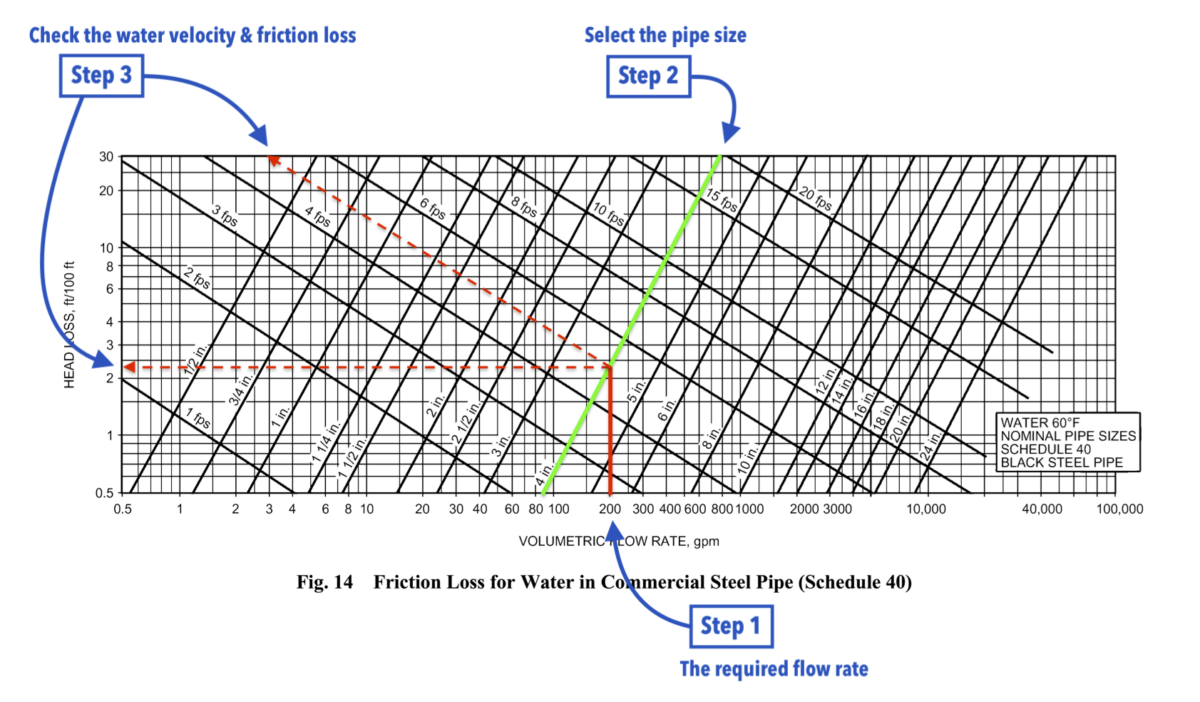
Sizing chilled water pipes using the ASHRAE friction loss chart involves 3 simple steps:
- Draw the required flow rate.
- Select the pipe size.
- Check the water velocity and friction loss.
In the case of the above example, the required chilled water flow rate is 200 gpm. Given that a 4″ pipe is selected, the resulting water velocity is 5 fps and friction loss is about 2.3 ft per 100 ft.
Based on ASHRAE’s recommendation, pipes above 2″ should have a friction loss below 4 ft per 100 ft.
Therefore, the above sizing is acceptable and the 4″ pipe is suitable for 200 gpm.
CARRIER Chilled Water Pipe Sizing Chart
The Carrier friction loss chart can be found in the Carrier Pipe Design Manual. Also, you can download the one with the sizing region marked in the above.
For an empty Carrier chart, the steps to size chilled water pipe are the same:
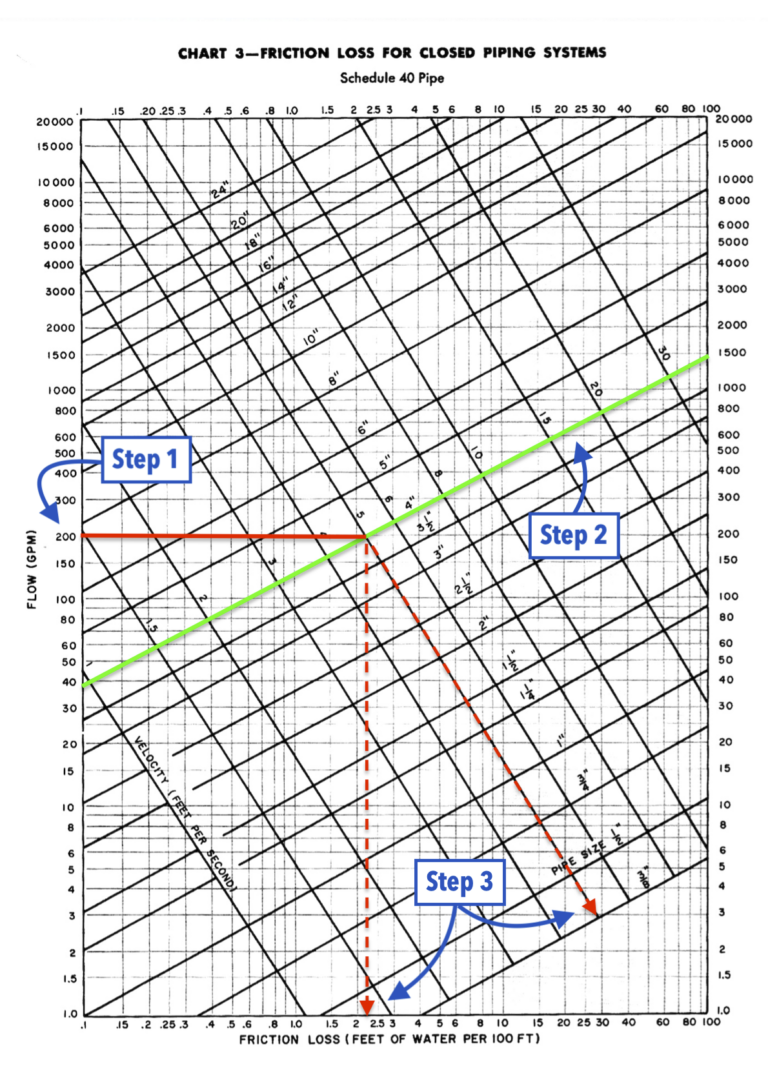
Although both charts are oriented differently, they produce the same result. Personally, I find the Carrier one easier to read and use.
It is easy to just follow the rule of thumb (velocity 4 fps, friction loss 4 ft per 100 ft) to size chilled water pipes. But, what are the underlying principles? Can we make changes? If so, what are the upper and lower limits?
Therefore, it’s important that we understand these limitations and how they affect the system.
Chilled Water Pipe Size Calculator
Enter your chilled water flow rate in GPM to calculate the suitable pipe size in inches:
Note: The result is based on ASHRAE recommendations where for 2″ pipe and below, the velocity limit is 4 fps and for above 2″ pipe, the friction loss limit is 4 ft per 100 ft. Continue reading to see the full guide on the sizing criteria.
Want to Learn HVAC in a More Structured Way?
This article explains one part of HVAC, but HVAC becomes much easier to understand when the topics are connected step by step. If you want a clearer learning path, explore my HVAC learning resources, including online courses, membership, corporate training, and 1-to-1 mentorship.
Need help with an actual project or system issue? View HVAC Engineering Services.
Chilled Water Pipe Sizing Criteria
Chilled water pipes are sized based on a certain limit of water velocity and friction loss. These limitations are the criteria we set to ensure good performance of our chilled water system.
Water Velocity
As mentioned earlier in this post, water velocity is the primary concern when sizing a chilled water pipe. In general, there are 3 factors to consider:
- System efficiency
- Pipe lifespan
- Noise
The heat transfer efficiency of chilled water fan coil unit drops when there are air bubbles in the chilled water. To eliminate air bubbles, chilled water systems typically use air-vent valves or an air separation unit (or both).
However, if the water velocity is too low, the chilled water won’t be able to carry the air bubbles to the air-vent valves (located at the highest point) or the air separation unit (could be in the basement).
Therefore, the minimum water velocity for chilled water pipe sizing is 2 fps (0.6 m/s) as recommended by ASHRAE.
While too low of water velocity can hurt the efficiency of the system, too high of water velocity is not desirable either.
As water moves through pipes, air bubbles (some are inevitable), sand and other solid matter will gradually erode the pipe. ASHRAE noted that erosion is not significant at below 10 fps.
Nonetheless, water velocity is inversely proportional to the lifespan of the pipe (in terms of operating hour) as provided by Carrier below.
| Normal Operation (hr/year) | Water Velocity (fps) |
|---|---|
| 1500 | 15 |
| 2000 | 14 |
| 3000 | 13 |
| 4000 | 12 |
| 6000 | 10 |
| 8000 | 8 |
In any case, the maximum water velocity for chilled water pipe sizing is 15 fps (4.6 m/s) as recommended by Carrier.
Another factor to consider when deciding what water velocity to use is noise.
When moving through straight pipes, high water velocity (even more than 15 fps) is not necessarily the cause of noise. While what actually can cause noise in pipes is not factually conclusive, it is generally the combination of high water velocity with a sharp turn or a significant decrease in the pipe size.
However, notable noise is produced when passing through a 1:4 orifice (eg: valves) at 10 fps. This is something that we need to take note when sizing chilled water pipes.
Based on different sections in the chilled water system, Carrier provided their recommended water velocities as below, accounting for the erosion rate and noise level.
| Service | Velocity Range (fps) |
|---|---|
| Pump Discharge | 8 – 12 |
| Pump Suction | 4 – 7 |
| Header | 4 – 15 |
| Riser | 3 – 10 |
For simplicity, I usually size most chilled water pipes based on 10 fps. Some of the professionals I know with more experiences prefer to use 9 fps.
In the end, it’ll all come down to experience and preference. What’s important is always keep the velocity above 2 fps and below 15 fps.
Friction Loss
The second factor which chilled water pipe size is based upon is friction loss. Friction loss is also known as pressure drop or head loss.
The decision concerning what friction loss to use boils down to one thing, the cost.
In short, low friction loss will result in bigger pipe size which increases the installation cost (material + logistic + labor). Vice versa, high friction loss will result in smaller pipe size which reduces the installation cost but increases the pumping cost.
If you have read my chilled water pump head calculation, you’ll know that pipe size directly affects how much pump head is required and friction loss pretty much dictates the pipe size.
Normally, the pipe material cost increases significantly at larger pipe sizes. This is partially due to the increased surface area and partially due to the increased amount of insulation for the chilled water pipe.
Take one of my previous projects as an example. The price of the 2″ pre-insulated chilled water pipe (20 ft long) is RM239.00 while the 2-1/2″ one is RM288.00. The difference is RM49.00. For the same project, the price of the 10″ pipe is RM1389.00 and the 12″ one is RM1685.00. The difference is a whopping RM296.00.
Chilled water pipes are available in standard sizes. Using a higher or lower friction loss may result in one pipe size difference.
Since there’s not much difference in the cost (relatively) between small pipes, it is better to use lower friction loss to size small pipes (below 4″) to reduce the pumping cost. And, it makes more economical sense to use higher friction loss for large pipes (4″ and above) to reduce the installation cost.
| Pipe Size (inch) | Pipe Size (mm) |
|---|---|
| 1/2 | 15 |
| 3/4 | 20 |
| 1 | 25 |
| 1-1/4 | 32 |
| 1-1/2 | 40 |
| 2 | 50 |
| 2-1/2 | 65 |
| 3 | 80 |
| 4 | 100 |
| 5 | 125 |
| 6 | 150 |
| 8 | 200 |
| 10 | 250 |
| 12 | 300 |
| 14 | 350 |
| 16 | 400 |
| 18 | 450 |
| 20 | 500 |
| 24 | 600 |
Nonetheless, the actual cost differences between pipe sizes must be analyzed separately as we all live in different places and work with different pipe vendors/suppliers.
Despite that, Carrier noted that in large air conditioning applications, between increased installation cost due to low friction loss (larger pipe) and increased pumping cost due to high friction loss, the balance point is often taken at a maximum friction loss of 10 ft per 100 ft (1000 Pa/m).
Whereas the lowest possible friction loss corresponds to the minimum water velocity of 2 fps for 2″ pipe and above which the friction loss should be 0.75 ft per 100 ft (75 Pa/m) as mentioned in the ASHRAE Handbook.
Apart from the cost, we need to consider the logistics and space availability.
Large pipes are much more difficult to handle than small pipes. At the construction site, small pipes can be carried by workers while large pipes require the use of tools such as a chain block which increases the amount of time required to install the pipe.
Furthermore, chilled water pipes are often installed above the ceiling. The space above the ceiling may not be sufficient to accommodate large pipes.
In addition, the nature of the project also plays a role in the decision-making process.
If the building will be constructed and operated by the owner, low friction loss (bigger pipe) may be preferred as the reduced pumping (operating) cost is beneficial to the owner for many years to come.
Under most circumstances, I use 8 ft per 100 ft to size chilled water pipes. Some of the engineers from the contracting business prefer 10 ft per 100 ft because their material cost is lower and hence, more profit.
Summary
Chilled water pipes are typically sized based on a velocity limit of 4 fps for 2″ pipe and below, and a friction loss limit of 4 ft per 100 ft for pipes over 2″.
The friction loss chart from ASHRAE or Carrier is an easily accessible tool for chilled water pipe sizing.
The minimum velocity for chilled water pipe sizing is 2 fps to ensure air bubbles can be eliminate for optimal performance. Whereas the maximum velocity in any case is 15 fps.
Smaller pipes resulting from high friction loss are beneficial to the installation cost but increase the pumping cost. It is more economical to use higher friction loss for large pipes because of significant cost difference.
Build Your HVAC Knowledge with a Structured Learning Path
If this guide helped you understand the topic, the next step is to learn HVAC in a more organized way. The HVAC Learning Hub helps you choose the right path based on your goal, whether you want self-paced courses, membership access, corporate training, or 1-to-1 mentorship.
Need project-specific advice, design, or troubleshooting support? View HVAC Engineering Services.

Hello Mr. Chang Zhen. Can you clarify the following line:
“Moving on to the orange region is where you size to favor a lower operating cost (lower pump power) which the allowable friction loss is higher but still within the recommended 10 ft per 100 ft.”
Wouldn’t the pump power be greater to overcome higher friction losses?
Hey Kenrick,
My mistake on that paragraph. I meant lower installation cost but higher pumping cost. It has been corrected. Thanks for pointing that out.