

AC Low Air Flow: 4 Ways to Fix Weak Airflow from Vents

AC low air flow is a common issue faced by many people and it is tricky to fix as there are several reasons. If you have weak air flow coming out of vents in your house. See if this post can help you identify the potential cause.
Low AC air flow is commonly caused by a dirty filter, coil or blower, which can be resolved by cleaning them. However, if the problem persists, there could be other technical issues such as high duct static, undersized return or wrong fan settings.
In some cases, supply vents in the house continue to have weak or almost no airflow despite getting the AC serviced. As such, there could be other underlying problems beyond the basics.
1. AC Low Air Flow due to High Duct Static
Every air conditioning unit or fan blower is designed to supply a certain amount of airflow at a specific condition. For instance, the 100k BTU gas furnace (5-ton AC) below supplies 2005 CFM of airflow at 0.5 in.wg of external static pressure in cooling mode.
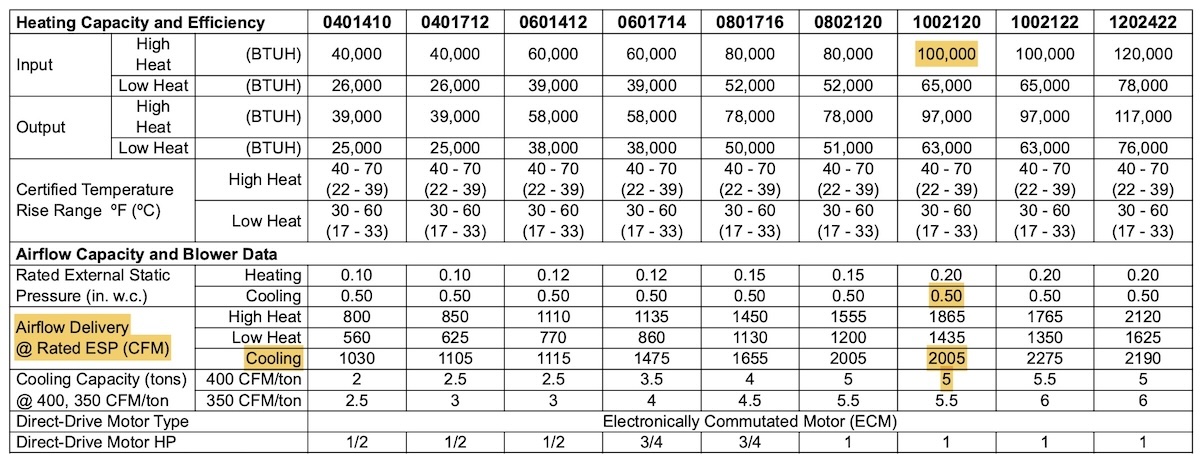
0.5 in.wg is a common external static pressure value for gas furnaces and other central air blowers. What this means is the blower is capable of delivering 2005 CFM if the duct static loss is 0.5 in.wg. If the duct static loss is higher, the airflow will be lower. If the duct static loss is lower, the airflow will be higher.
Duct static loss can be viewed as the total resistance present in the air distribution system (eg: blower connection, straight duct, flexible duct, duct collar, 90° bend, reducer, supply vent, return vent, return duct, etc.).
Each and every one of these components has a small resistance that the airflow must overcome. Together, they add up and the fan must be able to overcome this total resistance in order to deliver the airflow you need for adequate heating and cooling.
How much airflow is lost due to high duct static depends on the fan curve. However, fan curves are typically not provided in the gas furnace datasheet. Below is an example of the fan curve illustrating AC low air flow due to high static pressure:
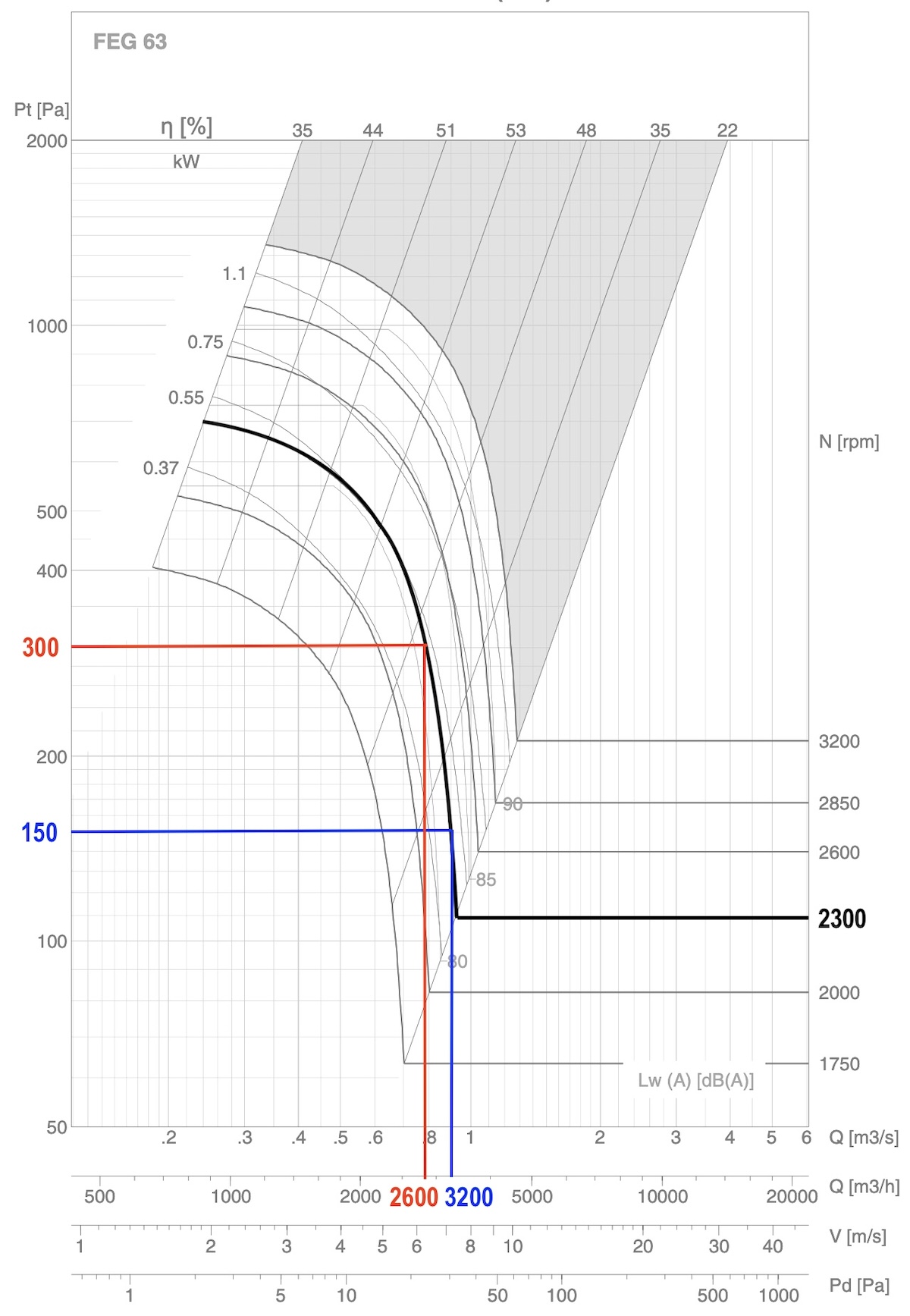
The above fan curve shows the fan operating at 2300 RPM. At 150 Pa (0.6 in.wg) of static pressure, the fan delivers 3200 m3/h (1882 CFM) of airflow. When the static pressure increases to 300 Pa (1.2 in.wg), the fan delivers 2600 m3/h (1529 CFM) of airflow.
The airflow reduction is nearly 20% when the static pressure is doubled and this is a pretty good fan in terms of handling static pressure. Other fans may lose far more airflow, resulting in poor heating and cooling.
Airflow significantly affects how much heating and cooling capacity you have. The formula is Q = mcΔT, which means if the airflow (m) is halved, the capacity (Q) is also halved.
Why High Duct Static Causes Low AC Air Flow?
Houses that use a central air system typically have multiple flexible ducts running from a main trunk (duct) to individual supply vents. Depending on the installation quality, these flexible ducts can induce significant static loss and they are often the culprit.
Below is an example of high duct static loss due to overuse of flexible ducts:
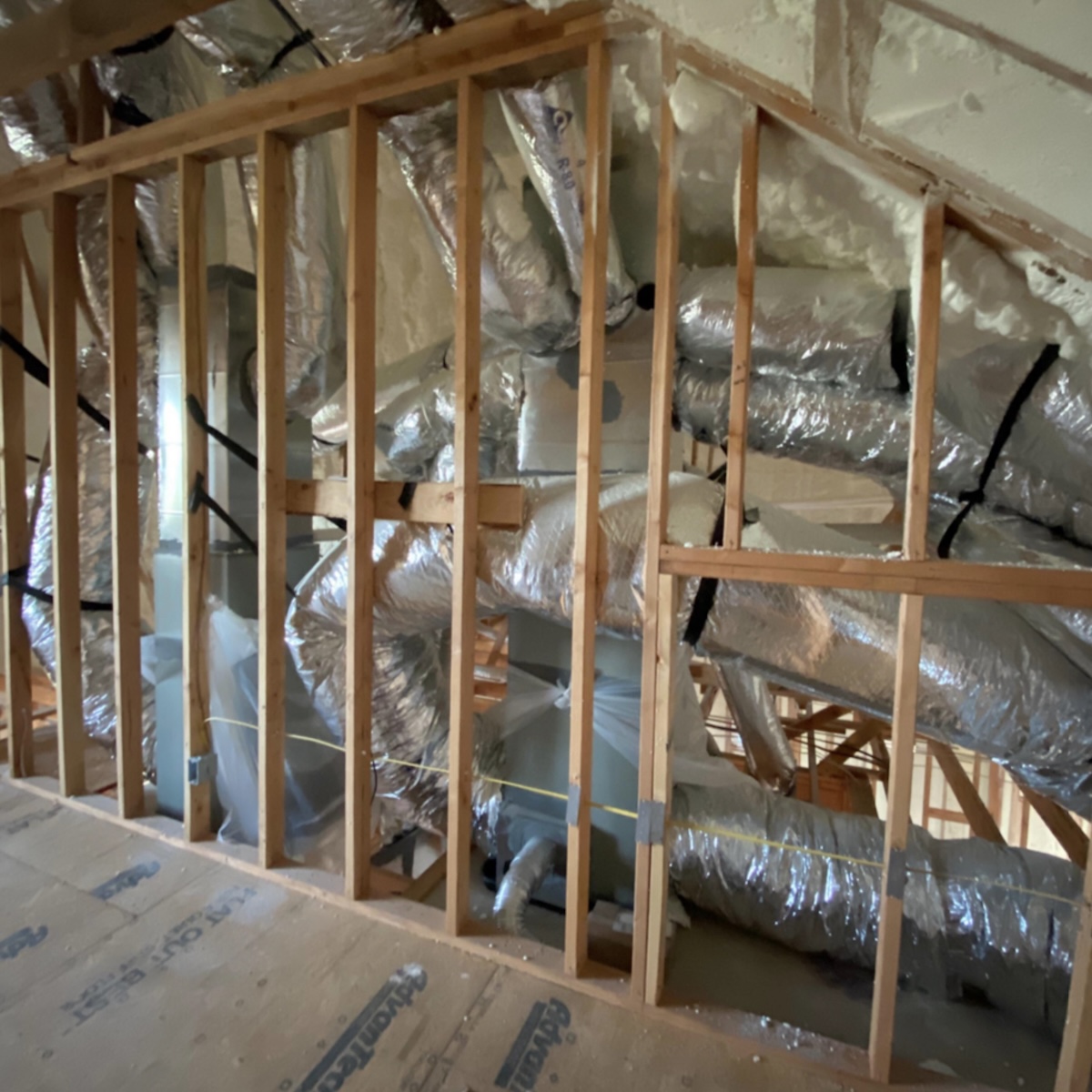
From what I see, overuse of flexible ducts is perhaps the number one reason for high duct static in houses. Some contractors are well aware of this and provide mitigation solutions to save cost, while some contractors may not be aware of this issue, leading to AC low air flow from day one.
How to Fix Low AC Air Flow due to High Duct Static?
High duct static can be due to a combination of problems, such as flexible duct too long, return vent too small, duct size too small or duct length too long. Start with the basics as follows:
- Check all filters (including those in return vents, if any), the cooling coil and blower. Clean them if found dirty and see if the airflow improves.
- If you have weak air flow from vents (one or two vents), then check their respective flexible duct for any blockage, compression or “kink”. If your vents have a damper for airflow control, check if it is accidentally closed.
- If you have a very old system, check if a significant amount of dust is collected within the duct.
Some of the problems can be ruled out by observing their symptoms. For example, if you remove the filter and the airflow immediately increases, the filter might be dirty or the duct static is too high. Or, your AC low air flow problem happens suddenly, not gradually. In this case, the blower motor might be faulty.
Another way to fix low AC air flow due to high duct static is to set your blower to a higher static pressure setting if available. Below is an example of blower settings for different airflow rates:
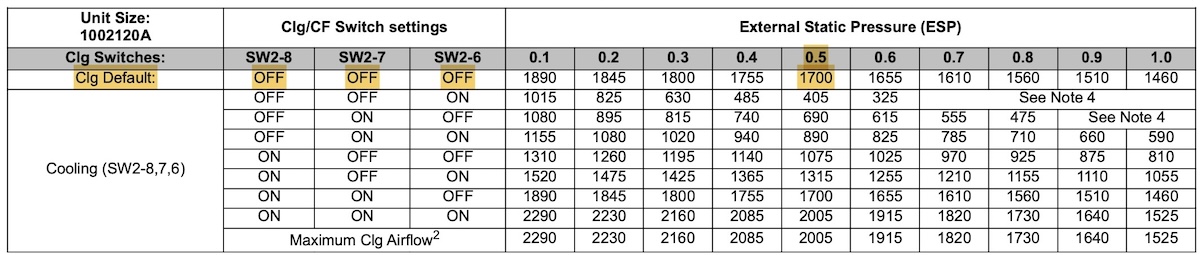
The above table shows that all three DIP switches of the blower are set to OFF, which results in 1700 CFM at 0.5 in.wg of external static pressure (ESP). If the actual ESP is 0.8 in.wg, the airflow will drop to 1560 CFM. But, if the three DIP switches are changed to ON, the blower will be able to deliver 1730 CFM.
If your blower is already at the maximum airflow setting, there is nothing much you can do except fixing the ductwork (eg: replacing flexible ducts with rigid ducts, rerouting the duct to shorten the path, increasing the duct size, etc.).
2. AC Low Air Flow due to Undersized Return
Undersizing the return vent could also be the reason for AC low air flow. A small return vent has higher airflow resistance. If the blower static pressure is just enough to overcome the duct, the return vent becomes the bottleneck.
This problem is more obvious as it could happen from day one, after the central air system or any other ducted air conditioning units (eg: ducted mini split, ceiling concealed, etc.) is first installed. Furthermore, a small return vent produces higher noise given sufficient blower static pressure.
See my post about return air grille sizing to calculate and check the appropriate return vent size. If what you currently have is 40-50% of the calculated size, you might have an undersized return.
How to Fix AC Low Air Flow due to Undersized Return?
Essentially, an undersized return vent causes high duct static. Thus, changing the fan static pressure setting (if available) could also fix the problem.
However, when you change the setting, the higher airflow may cause the undersized return to produce unpleasant noise. Thus, you may want to consider upgrading the return vent or adding more vents.
Adding more return vents at the right places can fix the AC low air flow problem while keeping the noise level reasonable. For example, branching out 1-2 short flexible ducts from the main return duct to the additional return vents in the hallway or living room.
3. AC Low Air Flow due to Wrong Fan Settings
AC low air flow could be simply due to wrong fan settings. As I explained earlier, furnace blowers have different static pressure settings (the dip switches). It could be that the contractor simply forgot to check the settings.
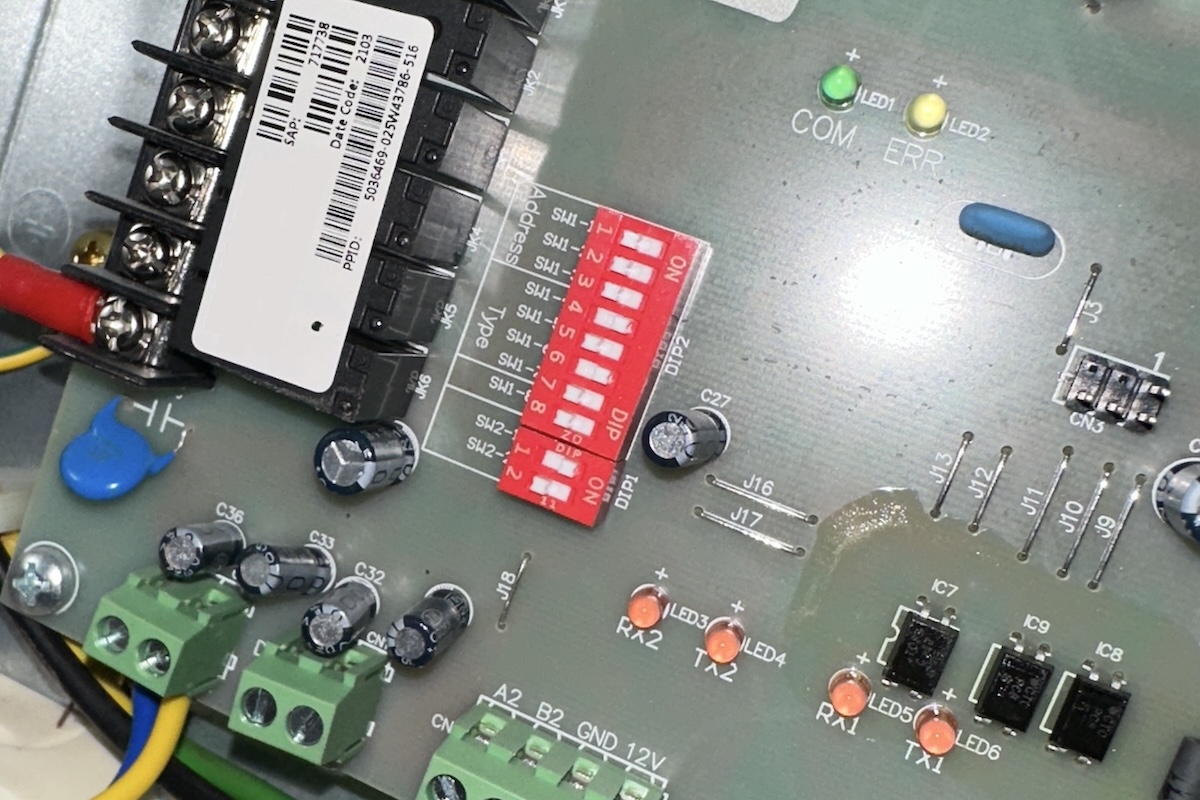
Some of the ducted mini split models also have fan settings. They are usually either low/med/high or 12/25/50 Pa (for example). It can be set using the remote/wired controller or overridden at the unit’s control board (typically dip switches as well).
4. AC Low Air Flow due to Dirty Filter, Coil or Blower
A dirty filter, coil and blower are one of the most common causes of AC low air flow. However, they are easily identifiable and fixable. However, some people may question if a dirty filter, coil or blower is the cause.
If the duct static is very close to your blower static pressure, any clogging of the filter, coil or blower is very obvious to your system. It may not be as obvious to other people’s systems because their duct may have a lower static loss than yours.
Different types of filters have different air resistance values. Below comparison shows that at the same 500 FPM of velocity, the initial resistance of a 2-inch thick MERV8 and MERV13 filters is 0.24 in.wg and 0.3 in.wg, respectively.

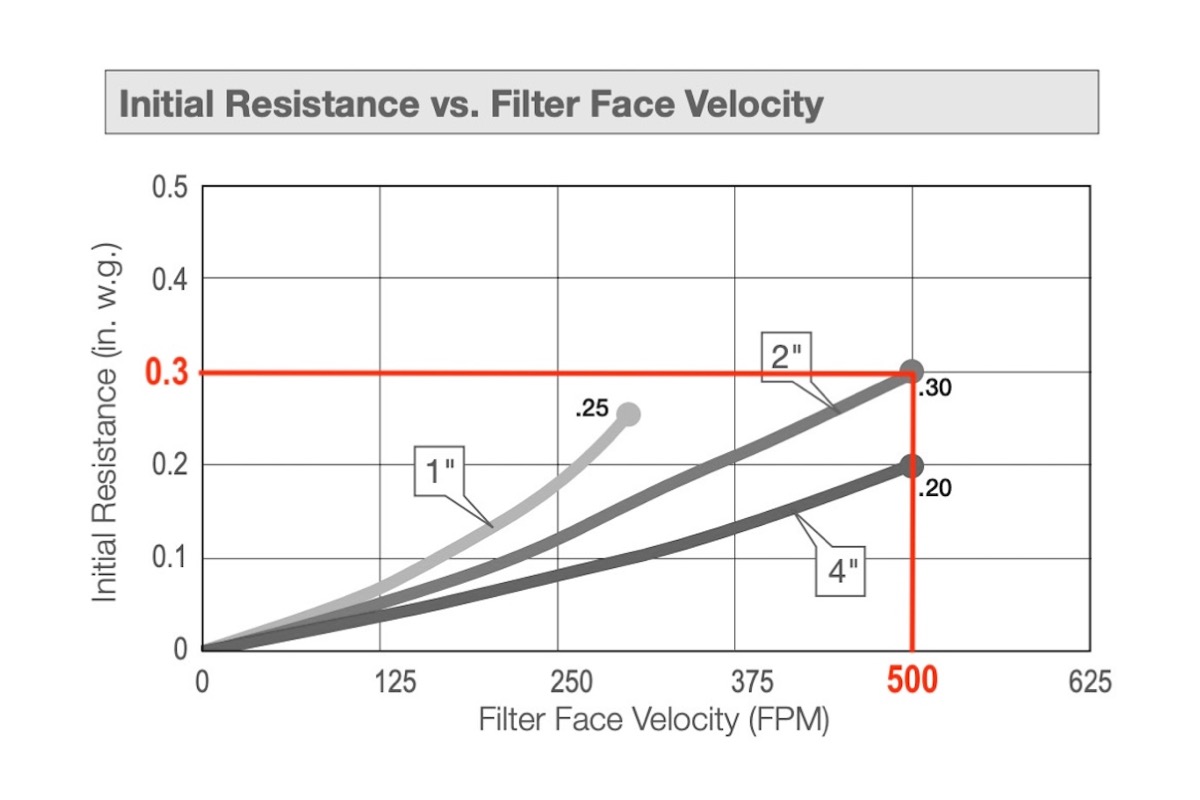
If your duct already has high static, using high MERV filters will further reduce the airflow. However, filters with better construction (for example, BNX TruFilter) may deliver the same filtration effectiveness at a lower pressure drop.
Nonetheless, these are problems that homeowners usually can resolve by themselves. High duct static and blower fan settings are trickier and often need technical assistance.