

What is a Water-Cooled Packaged Unit?

If you’re working in the HVAC industry, you might heard of water-cooled package unit. Water-cooled packaged units are not as common as some other types of air conditioners. So, what is a water-cooled packaged unit and how does it work?
Water-cooled packaged unit is a compact type of air conditioning unit that use water for heat rejection. The term water-cooled means the condenser side is cooled by water. Packaged means the evaporator and the condenser are located in a single unit.
There are a few types of water-cooled package unit. The working principle of water-cooled packaged unit is similar to conventional split ACs and water-cooled chillers. So, let’s see how a water-cooled packaged unit works.
Types of Water-Cooled Packaged Unit
Generally, there are 3 types of water-cooled packaged unit: a) floor standing, b) ceiling hung and c) free blow which is a variant of the floor-standing type.
A) Floor Standing
The floor-standing type is the most common type of water-cooled packaged unit. It sits on the floor, draws air from the side and discharge air at the top of the unit where a duct is connected to distribute air to multiple rooms.

B) Ceiling Hung
The ceiling hung type of water-cooled packaged unit is smaller in physical size and capacity. It is designed to fit above the ceiling. It also uses duct for air distribution.
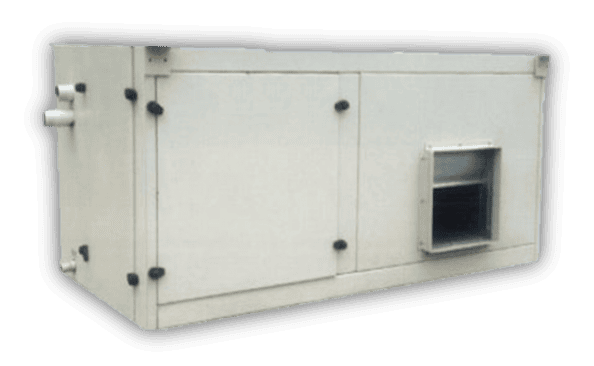
C) Free Blow
The free blow version of the water-cooled packaged unit replace the duct connection with a grille at the side of the unit. This means that the unit doesn’t required a duct and it can freely blow air to an open space.

Water-Cooled Packed vs Split AC
Water-cooled packaged units and split air conditioners have many things in common. By comparing them side-by-side, we can have a better understanding of what is a water-cooled packaged unit.
Split Air Conditioner
A split air conditioner has an indoor unit and an outdoor unit. The compressor is located inside the outdoor unit. The compressor send refrigerant to the condenser coil which is also located inside the outdoor unit.

The outdoor unit fan draws the ambient air through the condenser coil thereby taking away the heat. The refrigerant then goes to the expansion valve which is normally located inside the outdoor unit as well, especially for lower-capacity ACs. Higher-capacity ACs may have the expansion valve located inside the indoor unit.
The refrigerant then travels to the indoor unit via the copper tube. The indoor unit fan draws the room air through the evaporator coil thereby cooling the room. After absorbing the heat, the refrigerant return back to the compressor and the cycle repeats.
Water-Cooled Packaged Unit
Instead of having two separated units, a water-cooled packaged unit has all the components located inside a single unit. The compressor, condenser, expansion valve and evaporator are all located inside one unit.
The refrigeration cycle is the same as a split air conditioner. However, the biggest difference is the condenser.

The condenser side of water-cooled packaged units is much more complicated than split air conditioners. Pipes, valves, flow switch, water pumps and cooling towers are needed for heat rejection.
Therefore, in total, water-cooled packaged units occupy more space than conventional split ACs.
Components of Water-Cooled Packaged Unit
Despite having the same components as split air conditioners, water-cooled packaged units use a different type for certain parts.
The cooling coil (evaporator) of water-cooled packaged unit is the same as split air conditioners. Both use the finned-tube type of heat exchanger. However, water-cooled packaged units use a bigger fan, typically a centrifugal type.

With a bigger fan, water-cooled packaged units can handle much higher static pressure than split air conditioners. Typically from 100 Pa (0.4 in.wg) up to 200-250 Pa (0.8-1.0 in.wg).
A single unit of water-cooled packaged unit typically has two compressors. This gives the unit capacity control. One compressor consists of 50% of the total capacity.
Additionally, having multiple compressors also provides redundancy. If one compressor fails, the system still has 50% of the total capacity.
The condenser of water-cooled packaged unit is either shell-and-tube or tube-in-tube heat exchanger.
Unlike split air conditioners which use a finned-tube heat exchanger for their condenser, water-cooled packaged units use a different type of heat exchanger that is better for heat transfer involving water.
Brazed plate heat exchanger is another type of water-related heat exchanger.
Most water-cooled packaged units have a built-in control panel. The purpose of the control panel is to provide power supply. Other than that, it is common to have a display controller on the control panel where you can touch, set temperature, timer and even link it back to the building’s BMS system for data collection.
Want to Learn HVAC in a More Structured Way?
This article explains one part of HVAC, but HVAC becomes much easier to understand when the topics are connected step by step. If you want a clearer learning path, explore my HVAC learning resources, including online courses, membership, corporate training, and 1-to-1 mentorship.
Need help with an actual project or system issue? View HVAC Engineering Services.
Operation of Water-Cooled Packaged Unit
Water-cooled packaged units are designed to have free return, meaning they don’t need duct for the return side. So, the operation of water-cooled packaged units is simple.

Air is drawn from the side of the unit, passing through a filter and then the evaporator coil. The blower fan will send the air (typically) to the top of the unit where the duct connects.
At the condenser tube, water from the cooling tower will circulate in and out for heat rejection.
Typically, the operation of water-cooled packaged unit is controlled by either a return air temperature sensor or a thermostat located in the room. When the temperature sensor detects the temperature is above the setpoint, it’ll first signal the water pump and cooling tower to run.

The condenser side of water-cooled systems are crucial. We need to ensure the condenser water temperature and flow rate are stable before we start the compressor. Otherwise, the compressor may trip due to high pressure.
A flow switch is used to double confirm if there is indeed water flowing through the condenser tube. Once the flow switch registered the signal, the compressor can be started.
WC Packaged vs WC Chiller System
At the system level, water-cooled packaged units are a lot like water-cooled chillers. The major difference is where they perform the refrigeration process.
Water-Cooled Chiller System
In a water-cooled chiller system, the water-cooled chiller produces chilled water and send to the air handling units. The water-cooled chiller itself has the 4 components for the refrigeration cycle.

The air handling units don’t have any compressor or expansion valve in them. They only have the evaporator coil and a fan to draw air through the coil.
After the chilled water passes through the evaporator coil in the air handling units, it return back to the chiller with the support of a chilled water pump. That’s the heat absorption part.
For the heat rejection part, cooling towers are used to provide condenser water. With a condenser pump, the condenser water is supplied to the condenser side of the chiller. After absorbing the heat, the condenser water return back to the cooling tower to release the heat to the ambient air.
Water-Cooled Packed System
In a water-cooled packed system, there is no need for the chilled water part. Only the condenser water is needed to remove the heat from each water-cooled packaged unit.

Each water-cooled packaged unit has its own refrigeration process. Thus, we only need the condenser water for the heat rejection process. Therefore, water-cooled packed systems have fewer components than water-cooled chiller systems.
When to Use Water-Cooled Package Units?
Water-cooled packaged units have their own unique advantages. First, they are compact. Compared to chillers, water-cooled packaged units save space and need fewer equipment rooms. However, they’ll have more parts to service and maintain.
Secondly, water-cooled packaged units are designed to have minimal ductwork or not at all. They are designed to have free return and the free blow version can be completely duct-free.
Water-cooled packaged units are suitable for open area and medium-sized buildings. Without the need for ductwork, installation cost is greatly reduced. However, due to their static pressure limits, water-cooled packaged units can’t handle long duct length.
Another reason to use water-cooled packaged units is because of aesthetics. Split air conditioners require the outdoor unit to be hung outside the building which affect the exterior appearance of the building. Besides, service access is also a problem if the building is tall.
So, water-cooled packaged units can help by eliminating the needs for multiple outdoor units using a cooling tower that’s located on the roof which is not visible from the ground.
Water Quality Requirements
Just like any water-cooled systems, the quality of the condenser water is very important to water-cooled packaged units to prevent scaling and extend the lifespan of the system.
Chemical or non-chemical water treatment is needed to maintain the PH level, hardness and other water quality related parameters to keep good performance of the system.
Since cooling towers rely on the evaporation of the condenser water in order to cool it down, a makeup water tank is needed to replenish the condenser water whenever it falls below a certain threshold.
Build Your HVAC Knowledge with a Structured Learning Path
If this guide helped you understand the topic, the next step is to learn HVAC in a more organized way. The HVAC Learning Hub helps you choose the right path based on your goal, whether you want self-paced courses, membership access, corporate training, or 1-to-1 mentorship.
Need project-specific advice, design, or troubleshooting support? View HVAC Engineering Services.
