

Mini Split Alternatives: 4 Best Options Compared

Mini splits are efficient, quiet, and effective at both heating and cooling. However, they also have inherent limitations, including high installed cost, inflexible installation requirements, and strict indoor and outdoor unit clearances. If these constraints prevent you from installing one, what are the best alternatives?
In most cases, U-shaped inverter window air conditioners are the best alternative to mini splits. A box-style inverter window AC is the next-closest match, while a dual-hose inverter portable AC is preferable when window-mounted equipment or permanent modification is not allowed. Lastly, a packaged terminal heat pump is a viable alternative to a mini split for efficient heating.
However, there are certain things that only mini splits can do. Even with the best alternative, some compromises are inevitable. So, let’s look at the differences.
Alternative Options vs Mini Split
Below is a summary list of my recommended alternative options, ranking from “closest match” to “still comparable” with mini splits in terms of purchase cost, energy efficiency and noise level:
Scroll left on mobile to view the table in full.
| Alternative Options | Example Product | Approximate Purchase Cost | Energy Efficiency Rating | Estimated Annual Energy Cost | Noise Level on Low Speed |
|---|---|---|---|---|---|
| Ductless Mini Split Heat Pump |  | $500-$800 | SEER2 18-20 | $50–$55/year | 25-30 dB |
| U-Shaped Inverter Window AC |  | $350-$450 | CEER 13-15 | $60–$70/year | 35-40 dB |
| Box-Style Inverter Window AC |  | $300-$400 | CEER 13-15 | $60–$70/year | 40-45 dB |
| Dual-Hose Inverter Portable AC |  | $400-$600 | CEER 12-14 | $70–$80/year | 45-50 dB |
| Packaged Terminal Heat Pump |  | $950-$1200 | EER 10-13 | $80–$100/year | 50-55 dB |
Notes: 1) Purchase cost excludes installation cost. 2) Annual energy costs are approximate normalized estimates rather than direct rating-to-rating conversions because SEER2, CEER and EER are different efficiency metrics. 3) The noise figures indicate typical relative noise levels rather than a standardized laboratory comparison between every product.
The most distinctive advantage of mini splits is their high energy efficiency and quiet operation. So, an alternative should also be comparable in these two parameters.
Inverter window ACs have high enough efficiency to be a viable alternative. The U-shaped type is a better match because it operates quieter than the traditional box-style type.
Standard single-hose portable ACs are not a recommended alternative because of their low energy efficiency. In order for a portable AC to be comparable to a mini split, it needs to be a dual-hose type with inverter compressor.
A packaged terminal heat pump (PTHP) is recommended mainly because its heating capability is closer to that of a mini split. Other alternatives are mostly cooling only.
Apart from operational differences, the installation requirement is most likely the reason why an alternative is needed. This is where alternatives could be attractive.
Below is a comparison of my recommended alternative options and their typical installation requirement:
| Alternative Options | Typical Installation Requirement | Installation Method |
|---|---|---|
| Ductless Mini Split Heat Pump | Indoor and outdoor unit space, small wall penetration, refrigerant piping, permanent condensate drain, wiring, disconnect and required clearances. | Usually professional installation; selected DIY systems are available. |
| U-Shaped Inverter Window AC | Compatible window, outdoor projection, support bracket where required and suitable plug outlet. | Typically DIY and removable. |
| Box-Style Inverter Window AC | Compatible window, outdoor projection, support bracket where required and suitable plug outlet. | Typically DIY and removable. |
| Dual-Hose Inverter Portable AC | Floor space near a window or exterior opening, dual-hose panel, suitable plug outlet and possible condensate drainage. | Typically DIY, portable and non-permanent when window-vented. |
| Packaged Terminal Heat Pump | Large exterior-wall opening, wall sleeve, exterior grille, permanent condensate drain, weather sealing and suitable electrical supply. | Replacement may be straightforward; new installation usually requires professional wall and electrical work. |
One of the biggest reasons why an alternative is needed instead of a mini split is because of the high installation cost. As such, buyers can dial back down to an inverter window AC by compromising on slightly lower efficiency, slightly higher noise and an obstructed window view.
Another big reason why an alternative is needed is because of permitting requirements or building rules that prohibit any permanent modification such as hole drilling and hanging an outdoor unit outside the building.
As such, a dual-hose inverter portable air conditioner may be the only practical alternative. The discharge and intake hoses can be temporarily secured to the window to make the system functional. Compromises are much higher noise level, lower efficiency and a unit that occupies floor space.
Ventless portable ACs are not a comparable alternative to mini splits and they are not recommended for air conditioning. Ventless portable ACs are evaporative coolers, not a refrigerant-based system. They are more suited in hot and dry climates.
Best Alternative: U-Shaped Inverter Window AC

✅ What you gain
- 30-44% less purchase cost
- No refrigerant piping
- No separate outdoor unit
- No wall hole
- A removable unit
❌ What you compromise
- 20-30% higher energy cost
- ~10 dB higher noise
- A partially occupied window
- Limited heating option
Compared with a mini split, a U-shaped inverter window air conditioner saves you 30-44% on purchase cost with no additional installation cost, simpler installation, easier to service and maintain, and an overall more compact system that can be removed or relocated as desired.
However, you’ll pay 20-30% more on energy cost, get a noisier but still bedroom-suitable unit, live with a partially occupied window, and you may need a separate system for heating.
Verdict: Considering its much lower installed cost, modest energy-cost penalty and bedroom-suitable noise level, a U-shaped inverter window air conditioner is the best overall alternative to a mini split.
Example product: Midea 12,000 BTU U-Shaped Smart Inverter Window Air Conditioner
A conventional fixed-speed window AC may still cool efficiently enough, but its compressor cycling, sound profile and temperature control make it a less convincing substitute for the variable-capacity operation of a mini split.
Option 2: Box-Style Inverter Window AC

✅ What you gain
- 40-50% less purchase cost
- No refrigerant piping
- No separate outdoor unit
- No wall hole
- A removable unit
❌ What you compromise
- 20-30% higher energy cost
- ~15 dB higher noise
- An obstructed window
- Limited heating option
Compared with a mini split, a box-style inverter window air conditioner saves you 40-50% on purchase cost with no additional installation cost, simpler installation, easier to service and maintain, and an overall more compact system that can be removed or relocated as desired.
However, you’ll pay 20-30% more on energy cost, get a noticeably noisier unit, live with an obstructed window view, and you may need a separate system for heating.
Verdict: Considering that it is much cheaper to install, the energy cost difference is not much, and the noise could be acceptable in certain scenarios, a box-style inverter window air conditioner is the next-best alternative when a U-shaped window AC is unsuitable.
Example Product: Frigidaire Gallery 12,000 BTU Smart Inverter Window Air Conditioner
A conventional fixed-speed window AC may still cool efficiently enough, but its compressor cycling, sound profile and temperature control make it a less convincing substitute for the variable-capacity operation of a mini split.
Option 3: Dual-Hose Inverter Portable AC
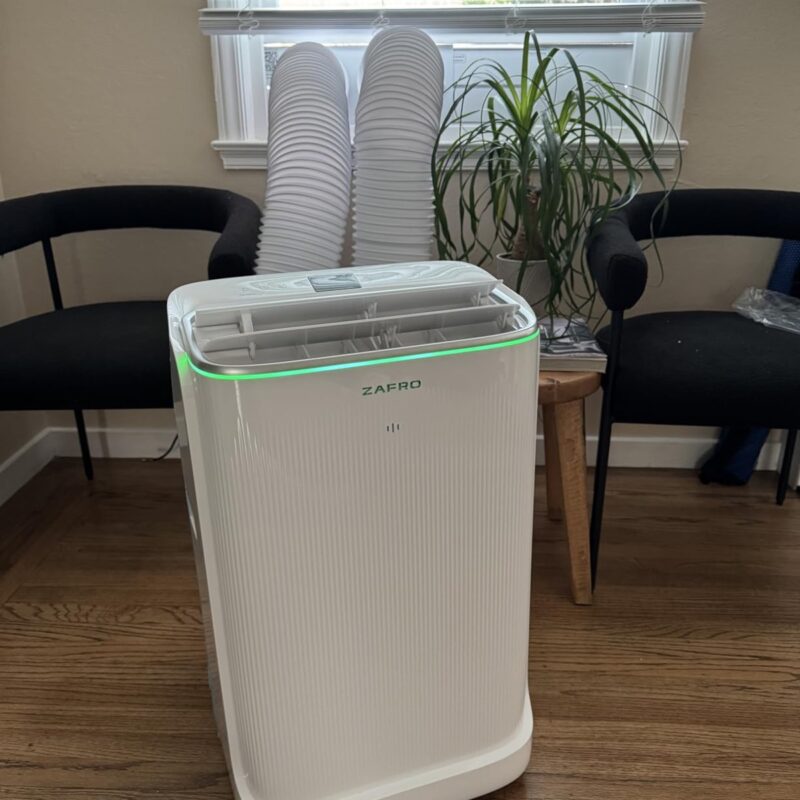
✅ What you gain
- 20-25% less purchase cost
- No protruding unit
- No refrigerant piping
- No separate outdoor unit
- A plug-and play unit
❌ What you compromise
- 40-45% higher energy cost
- ~20 dB higher noise
- Less usable floor space
- Condensate management
- Limited heating option
Compared with a mini split, a dual-hose inverter portable air conditioner saves you 20-25% on purchase cost with no additional installation cost, simpler installation, easier to service and maintain, and an overall more compact and flexible system.
However, you’ll pay 40-45% more on energy cost, accept considerably higher indoor noise and sacrifice some usable floor space, and you may need a separate system for heating.
Verdict: Because a portable air conditioner requires minimal permanent modification and doesn’t have any outdoor bracket or condenser protruding out the window or wall, it may be the only allowed option that has good enough performance to be comparable to a mini split.
Example Product: ZAFRO 12000 BTU (SACC) Dual Hose Inverter Portable Air Conditioners
Conventional single-hose portable ACs generally make poor mini-split substitutes because their room-depressurization effects, lower effective capacity and higher indoor noise impose much larger compromises.
Last Option: Packaged Terminal Heat Pump (PTHP)

✅ What you gain
- Heat pump heating
- No refrigerant piping
- No separate outdoor unit
- A compact system
❌ What you compromise
- ~50% higher purchase cost
- 60-81% higher energy cost
- ~25 dB higher noise
- Large wall opening
Compared with a mini split, a packaged terminal heat pump gives you heat-pump heating with electric resistance backup for better reliability, straightforward replacement, easier maintenance, and an overall more compact system.
However, you’ll pay about 50% more on purchase cost but potentially require little additional installation work when replacing an existing compatible unit, expect 60-81% higher energy cost, and you must accept a much louder unit.
Verdict: Considering that packaged terminal heat pumps are available in larger capacities, provide reverse-cycle heating, and are simpler to replace when a compatible sleeve already exists, they can be a practical option when efficient room heating is essential.
Example Product: Cooper & Hunter 15,000 BTU Packaged Terminal Air Conditioner & Heat Pump
Basic fixed-speed PTACs that rely primarily on electric resistance heating are poor mini split alternatives because of their cycling noise and high heating energy use.
What Mini Split Features Can’t Be Replaced?
Although the alternatives offer attractive gains in exchange for some compromises, there are things that a mini split does better and no other alternatives can effectively replace.
1. Low Noise at High BTUs
U-shaped inverter window air conditioners and other inverter units may be able to approach the low noise operation that mini splits are famous for, but they can never achieve the same at higher BTUs.
Mini splits are inherently quiet because the noisiest component, the compressor, is located far away from the occupied space. At higher BTUs, mini splits are only slightly noisier due to higher indoor airflow.
Whereas for window and portable ACs, higher BTUs means larger compressor and thus, significantly louder noise. They are inherently noisy because their compressor is located at close proximity.
This is also part of the reason why PTHP is louder.
2. Flexible Indoor Placement
The location of window ACs is dependent on the location of the window. While portable ACs placement is flexible, they are still dependent on their hose length relative to the nearest wall opening or window.
PTHPs avoid a separate outdoor condenser, but their placement is restricted to a large exterior-wall opening. They also cannot be ceiling-mounted or concealed above a ceiling like some mini split indoor units.
On the other hand, mini splits have a variety of indoor unit types you can choose from depending on your needs. Ceiling cassette mini splits can be hung on the ceiling, floor-standing units can be placed on the floor, and ceiling ducted units can be concealed and run with ductwork.
The degree of indoor placement flexibility a mini split provides is unmatched.
3. Powerful Heating
Window and portable ACs with heat are much more expensive than cooling only models and they are not recommended to be the only source of heating. They provide supplemental heating.
PTHPs provide efficient heating with heat pump but standard PTHPs generally have weaker low-temperature heat-pump performance and may switch to electric resistance heat as outdoor temperature falls.
Meanwhile, mini splits with low ambient heating capability can work at -13°F outside air temperature. When appropriately sized and selected, cold climate mini splits can serve as the primary heating system in many homes.
4. Whole-House Application
Most window and portable ACs are ranging from 8000-14000 BTU, although larger window units are available. The highest PTHPs for residential use is around 15000 BTU. This makes larger-scale applications not viable for these room air conditioners.
Mini splits are commonly available up to 24000 BTU, some even up to 36000 BTU. The multi-zone line up even can connect multiple indoor units to a single 3-ton or 4-ton outdoor unit, making whole-house applications more viable.
In fact, for an entire house, two multi-zone mini split systems or a single variable refrigerant flow (VRF) system (a scaled-up mini split system) is increasingly common.
Choose an Alternative Based on Your Constraint
The best alternative depends on which mini-split limitation prevents you from installing one.
| Your Main Constraint | Best Alternative |
|---|---|
| Mini-split installation is too expensive | U-shaped inverter window AC |
| U-shaped model does not fit the window | Box-style inverter window AC |
| Building prohibits permanent alteration | Dual-hose inverter portable AC |
| No separate outdoor condenser is allowed | Window AC, portable AC or PTHP |
| Window cannot support an AC | Portable AC or PTHP |
| Heating is essential | PTHP |
| An existing PTHP sleeve is available | PTHP |
If you’re unsure which alternative you should go for, or you have a project that you’re trying to decide which system to use, I do provide HVAC advisory and consultation, just send me a request.
Need HVAC Engineering Support for Your Project or System?
If you are planning an HVAC installation, reviewing a contractor proposal, checking a design, or troubleshooting a real system issue, I provide practical HVAC advisory, design documentation, and selected on-site assessment support.
Want structured courses, membership, corporate training, or 1-to-1 mentorship? Start Learning HVAC.